
Retrospectives: An Interview with Lindsay Bernal Posted in: News, Interviews

RETROSPECTIVES:
Lindsay Bernal
In the Retrospectives interview series, readers have a chance to catch up with previous winners of the Open Competition and see the winding paths they’ve taken since receiving the award and having their books in print. How has their writing grown with time? How have their artistic persuasions and worldly perceptions shifted? Retrospectives considers the changing writerly self and the opportunities that found these poets after their big win.
What first drew you to poetry? What draws you now?
Its compression, its unique capacity to consider opposing ideas, juxtaposition, contradiction. Before I knew anything about Keats I was interested in negative capability—I suppose the feeling of negative capability predates my introduction to the literary term.
I wanted to make sense of my own psychic chaos and I wanted it to sound on the page like it sounds in my brain.
Before I gave into the desire to write poems, I came to poetry as a reader—I didn’t keep a diary or journal as a child or teenager. And the first poems I inhabited were in Spanish, not my native language, as a high school student. Lorca, primarily, through his trilogy of plays, Bodas de Sangre, Yerma, and La Casa de Bernarda Alba. Then, in college, I discovered Borges, Guillén, Mistral, Sor Juana. Because I first learned to read and analyze poems in Spanish, I was trained to look for patterns, figures of meaning, when I didn’t fully understand everything, which continues to inform my approach to poetry’s mysteries, what we can’t know in a poem.
Eventually, writing my own poems became an antidote to writing about other people’s poems. In my final year of undergrad, I realized I didn’t have the stamina to be a Latin Americanist, a scholar, but I had caught the poetry bug and I still haven’t been cured of it. Since I wrote my first poem for an intro workshop, I’ve never been able to not write poems. Believe me, I’ve tried.
In the years since you wrote your winning manuscript, have you tackled new themes or subjects you didn’t expect? Was it a matter of confidence, or finding new skills and techniques?
I’m always tackling new themes and subjects. Otherwise, writing is a boring enterprise.
Finding my subject has never been my problem. I have endless ideas for poems. I do actively keep a notebook now and it’s filled with fragments, seeds.
Winning the NPS didn’t give me the confidence or skills to explore new material, but it meant that my first book would finally be published and I could stop revising the manuscript, which I’d been doing for about five years. It cleared my desk, and I could commit to the next thing, the poems that would become the next manuscript. I’m not good at multitasking or compartmentalizing projects, so I was free at last to let go of the first book.
How has your poetic voice grown over time? How do you support this growth: reading poetry, trying new poetic forms, embracing discomfort, etc.?
Pass. Just kidding. Your voice as a poet is an elusive concept. After my first semester as an MFA student, my teacher told me I needed to find a new voice. I remember writing down this directive in my notebook as if a new voice were something one could find over winter break. Basically, I trashed all the poems I wrote that fall but I did experience a creative breakthrough over the next year. I took two “poetic forms” courses that were indispensable to my growth, one on the Long Poem in which I wrote a poem of 150 lines (all one stanza, without section breaks) and another on free-verse prosody in which I wrote in regular meter and various stanza forms (common measure, terza rima, Anglo-Saxon verse, blank verse, real sonnets, etc.). My long poem for the class evolved into two long sequences “The Pre-Raphaelite Effect” and “Venice Is Sinking,” companion poems in What It Doesn’t Have to Do With. The metrical experiments all failed, but the ghosts or remnants of that experimentation remain present, audible, throughout my first book.
Writing is an uncomfortable process for me that I resist daily until my resistance to it leads to rage and anxiety that can only be quelled by writing. I am so sorry that my husband with whom I’ve cohabited for 20 years has to endure my process.
Has your work responded to changes in culture or social conditions? What has that looked and felt like as a writer, in big or small ways?
Definitely. I can’t ignore pop culture or the socio-political landscape. I consider myself a feminist and thus, a feminist writer. My first book tracks the objectification of women in various art forms (by men) throughout history. When writing What It Doesn’t Have to Do With, a book that angularly, somewhat obliquely, confronts my experience of sexual assault, I couldn’t have imagined that the United States would elect Donald Trump (twice), the second time after the Women’s March, after Me Too.
In my unpublished manuscript, the speaker navigates the power structures that have imposed themselves on her in this specific moment of systemic misogyny by examining and embodying the narratives of women artists, writers and visionaries throughout history who have defied these hierarchies. The poems explore my assault more directly, the ubiquity of “rape culture,” the decision to not become a mother through a personal, political and environmental lens, and the rejection of my religious education.
Sexual violence and abuse were endemic to the community in which I was raised—I attended Catholic schools from nursery school through high school; my brothers went to a Jesuit school. My recent poems introduce other institutions (academia, Western medicine) that have failed to protect and listen to women.
I’m writing more ecopoetry (aren’t we all?) as solastalgia, resource extraction, species collapse, widespread contamination, and natural and unnatural disasters become our shared reality in the 21st century.
How have your writerly habits (e.g., a daily practice, a preferred beverage at your side, music, writing analog) transformed since starting out? Is there a habit you want to develop or continue?
When I first began writing, I could easily get lost in a poem–I wasn’t yet the self-editor I’ve grown or devolved into. As we study an art form or professionalize ourselves as artists, we forsake some of the play, the risk. I can get closer to that initial wildness in my notebook, a big unlined artist’s sketchbook. LePen and Pigma Micron are my choices for pens in bright, bold colors. I delay the laptop phase of writing as long as possible. Because I can delete swaths of language in Word, I can kill a poem on my laptop before I’ve understood what it is I’m making. I prefer the cut as a revision strategy and I have to willfully fight against that preference. I often delay breaking language into lines as well. As a writer, I’m too tight, too controlled, and clever enjambments sometimes prevent me from being messy enough to discover the imaginative expanse of a poem.
I’m skilled at ending a poem, getting out of it or shutting it down in a satisfying way. Over the last decade or so, I’ve been practicing going past what I perceive as the end, continuing to open it up, expose more layers, more angles. What It Doesn’t Have to Do With is made up of long poems in sequence and half-page and page-long poems. My unpublished manuscript contains poems that are two or three full pages. I’m still working on what may be the long poem in the new collection.
Another vital, ongoing part of my practice is looking at art. What It Doesn’t Have to Do With could be a time capsule of the exhibitions I saw in New York in the early aughts, Matthew Barney’s Cremaster Cycle at the Guggenheim, the John Currin retrospective at The Whitney, the opening of Dia Beacon. I moved to DC in 2004 and the art moves with me (or I move with it): there was a Louise Bourgeois retrospective, Femme Maison, in 2009 at the Hirshhorn; a Man Ray exhibition at the Phillips Collection. I encountered Celia Paul’s St. Brigid’s Vision (the foundation for my second book) in 2016 in the Rubell Family Collection’s exhibition, No Man’s Land, at the National Museum of Women in the Arts.
I live in Baltimore now, haunted by Grace Hartigan’s ghost, within walking distance of the Baltimore Museum of Art.
Writing beverage: coffee! I would drink coffee all day long if I could. I prefer the pour over method I use at home. If I’m not at home, a cortado.
In winning the competition, you received $10,000 and publication. How did these things shape your life and path as a writer? Did this lead to other opportunities or a shift in your self-perception?
First off, I am forever indebted and immeasurably grateful to the National Poetry Series readers and Paul Guest for selecting my book. I’ve had the honor of reading for the series–there are so many incredible submissions.
With the prize money, I paid off the compounding debt I’d accumulated as a graduate student in DC, where the cost of living was skyrocketing.
Once my book was in production, my po-biz-savvy colleagues told me I had to sell books to launch my “career.” Poetry entering the marketplace, becoming marketable, is problematic (IMO). Most of the writers and artists I love were not popular during their lifetimes—I’m most inspired by the poets and poems with afterlives.
I’m really of two minds when it comes to visibility. My poems are private and intimate—that they take on a public life through publication is challenging for me. When I’m writing a poem, I’m not thinking about audience, but when I’m reading from my book at a bookstore or university, there’s a live, breathing audience—beyond my teachers, my MFA cohort, and my friends from various writing communities. Reaching readers, in other words, has been both gratifying and terrifying.
Obviously, prizes and publication are validating, but, apart from freeing up imaginative space, they don’t help you write the next poem. I’m still overwhelmed by self-doubt when I start something new.
Because writing is a difficult vocation that requires thick skin, I had to learn to equalize acceptance and rejection, to temper my reaction to both. What It Doesn’t Have to Do With is my first book and it was rejected for five years (hundreds of rejections) before it won the NPS.
Have you written another book since the one published with The National Poetry Series? How is The National Poetry Series book similar or different?
Yes, I have an unpublished manuscript–in editors’ hands. It’s dedicated to one of my dearest friends, the poet Elizabeth Arnold, who died before I finished it.
I wrote most of my NPS book, my first book, in my 20s. I wrote the unpublished manuscript in my 40s, my perimenopausal book! In all seriousness, What It Doesn’t Have to Do With, is an extended meditation on my sister-in-law’s suicide, and it’s an urban book that traverses multiple cities. The new manuscript, written during a global pandemic, is more pastoral, more ecopoetic, more situated in domestic life.
I’ve always connected the confessional with the elegiac and that connection persists across the two books. The unpublished manuscript addresses my lapsed Catholicism: as a child and teenager, I regularly confessed my failings to a priest and promised to revise myself. It seems only natural that the confessional is definitional to my poetics and almost all my poems emerge from and contemplate failure.
Ekphrasis, intertextuality, and allusion are part of my practice–in both books, these techniques provide indirect ways of processing lived experience or autobiography on the page. In What It Doesn’t Have to Do With, I interrogate art by men almost exclusively. In the new manuscript, I planned to only reference work/testimony by women and I largely succeeded: Christine Blasey Ford, Grace Hartigan, Margery Kempe, Madonna, Joan Mitchell, and Elizabeth Arnold are all very present, but Manuel Álvarez Bravo, Matisse, and Milton also snuck in.
Who are the poets who have continued to engage you?
Sylvia Plath is still my favorite poet. I read Heather Clark’s transcendent biography of her while I was working on the new manuscript–I can’t recommend it more highly.
Mina Loy. Gertrude Stein. Lorine Niedecker. Elizabeth Arnold, who taught me how to read Loy, Stein, and Niedecker.
Maud Casey doesn’t consider herself to be a poet, but I do.
Elizabeth Bowen’s prose is more lyrical than most lines of poetry.
Yiyun Li’s recent book, Things in Nature Merely Grow, is a poet’s memoir.
Celia Paul writes about painting in the way I think about poetry. Her “memoirs,” Self-Portrait and Letters to Gwen John, and her sea paintings led me into my second book.
If you could talk to your younger self, the version of you before you won, what would you say to yourself? What advice would you give?
Don’t throw away What It Doesn’t Have to Do With, which I almost did. Don’t join Instagram. I’ve never wasted as much time as I have since I’ve been on social media. I don’t know how folks manage multiple platforms and still write good poems.
Answer an unasked question. What’s the question, and what’s the answer?
What’s your favorite album right now?
Train on the Island by Aldous Harding, the daughter of a poet.
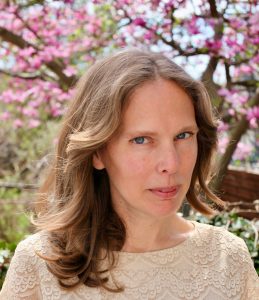
Lindsay Bernal is the author of What It Doesn’t Have to Do With (University of Georgia Press, 2018), winner of the National Poetry Series. Her recent poems appear in Chicago Review, the Georgia Review, the Hopkins Review, New England Review, Oversound, Poem-a-Day, and other journals. She coordinates the MFA Program in Creative Writing at the University of Maryland, where she also directs the Writers Here & Now reading series and teaches undergraduate poetry workshops and courses on poetics.