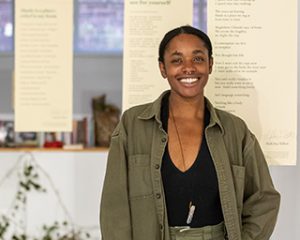
Retrospectives: An Interview with MaKshya Tolbert Posted in: Interviews

RETROSPECTIVES:
MaKshya Tolbert
In the Retrospectives interview series, readers have a chance to catch up with previous winners of the Open Competition and see the winding paths they’ve taken since receiving the award and having their books in print. How has their writing grown with time? How have their artistic persuasions and worldly perceptions shifted? Retrospectives considers the changing writerly self and the opportunities that found these poets after their big win.
What first drew you to poetry? What draws you now?
What first drew me remains a bit of a mystery. As a kid, I wrote a bunch of poems, yet can’t remember where I started. Or why. Recently, I found an email from 2007 where I was asking a friend’s dad to “introduce me to poets.” I remember wanting poetry to fix or shapeshift some of what was happening around me.
Now, I’m drawn to the bewilderment that I was just saying I couldn’t begin to understand. Never quite knowing what to say or make of being alive on Earth compels much of my writing toward how to be here as I flail through being here. I have a deep admiration and commitment for practicing how to be a part of the ‘flux’ of things.
In the years since you wrote your winning manuscript, have you tackled new themes or subjects you didn’t expect? Was it a matter of confidence, or finding new skills and techniques?
Shade is a place came out in 2025 and so I’m just now getting a real chance to open myself up to the wonder and challenges of a new project, because of how I am. Shade is a place and its many opportunities to gather have given me the courage to write toward more intimate material, practice, and inquiries in my writing. But I’m still in the forest, though with more ecological and emotional entanglements each time. I’m trying to write alongside trees, rather than from behind them . . . I look back and see myself hiding, sometimes. So yes–I’m glad you mentioned confidence because Shade is a place renewed some of mine, and has given me the audacity to try to get more vulnerable in and around my writing. Starting with softening my grip, and my eyes.
How has your poetic voice grown over time? How do you support this growth: reading poetry, trying new poetic forms, embracing discomfort, etc.?
Maybe my voice is changing as my own personal and emotional capacity for self-inquiry widens, expands, and changes on me. I wonder often about my fear (sometimes ‘the fear’) and my heart and how both make their way into and through my writing, whether I like it or not. What supports my growth right now is taking my heart and its stakes seriously as I both live and write. Shade is a place broke my heart to write; I constantly wanted the shade walks and poems to earnestly offer me some relief, some sense of place. And I could feel the fragility, the shakiness, the stubbornness. I could feel all of it in my walks and my writing. What grew the poetic voice I have—which scares me sometimes and which other times is nowhere to be found—has been listening to how it sounds. And really responding to it. I find that my poems and their voice are responsive to my insistence on loving my own. Anne Sexton said it best in her poem, “Live,” where she writes, “I promise to love more if they come.”
Has your work responded to changes in culture or social conditions? What has that looked and felt like as a writer, in big or small ways?
Yes, on the kinder days. On those days, my writing both picks up on and responds to atmospheric conditions of time and place. I do feel the work is porous, and feels around for a sense of place and form in some entangled relationship to ambient conditions. I find my work at its best is sensitive—responsive at its heart—to the flux of things. Almost ravished by it . . .
The unkind days are days when my writing struggles to be responsive at all. The poems seem to lack the same interoceptive (internal listening, or a sense of feeling and responding to what’s happening inside you) and exteroceptive capacities I lack or am working to recover (we need the kinder self-talk).
Cue that same thought I mentioned earlier about practicing letting habits in and letting habits out . . .
How have your writerly habits (e.g., a daily practice, a preferred beverage at your side, music, writing analog) transformed since starting out? Is there a habit you want to develop or continue?
I’ve been fixated this year on habit stacking, across various areas of my life. Any change I actually plan on seeing through has to touch most parts of my life, I’m learning. And, I’ll admit it’s getting a bit unwieldy . . . but I wanted to explore my capacity to let some of my less-generative habits go, and invite more generous ones in (time will tell us how I’m doing). I’m sharing this tiny dispatch into what I’ve been up to with myself because resequencing my patterns, movements and decisions—and maybe my brain!—has me curious to see how habit work relates to the ‘work’ of practicing poetry.
How it’s going—the habits, the poems—both keep surprising me.
In winning the competition, you received $10,000 and publication. How did these things shape your life and path as a writer? Did this lead to other opportunities or a shift in your self-perception?
Shade is a place has given me new elsewheres to put my attention, my time, my curiosity.
While writing these poems and taking these walks, attempting to be an “invitation” into a fragile sense of place and self among the city’s ‘shade trees’ was as much an invitation into the flux of my inner life and the environment, as it was a way to explore the flux of how I practice poetry. I’m falling hard for landscape design and cultural landscapes projects, though it’s leading to mostly bewilderment I don’t know what to do with, and a lot of misadventure! But I’m working collaboratively on a National Memorial to the Underground Railroad, and the ecospiritual life of Black enslaved laborers among and toward their kin and environments has given me new breath that should have been theirs.
Have you written another book since the one published with The National Poetry Series? How is The National Poetry Series book similar or different?
Shade is a place is my first book! It’s been an honor to debut through the poetry series, and I’m curious to see where the writing and I go from here.
Who are the poets who have continued to engage you?
I’m sure I’m not the only poet whose gut response to this question is “ugh!” So many people come to mind but without thinking too hard, the following poets come to mind:
Kiki Petrosino, Reginald Shepherd, Susan Stewart, Brian Teare, G.E. Patterson, Christopher Gilbert, June Jordan, A.R. Ammons, Anne Sexton, Kameryn Alexa Carter, Cecily Parks, and Hajjar Baban.
I wouldn’t even know where to start, so I’ll just leave their names here. You didn’t ask, but Hajjar’s book, Low Flying Planes (Milkweed, 2026), and which comes out in August, is what I’m most looking forward to reading this year!
If you could talk to your younger self, the version of you before you won, what would you say to yourself? What advice would you give?
That your fears are not true. And that softening your eyes and your grip will direct you toward the book that is yours. Don’t spend that time waiting for someone else to do this first, or for you.
. . . and let your heart break sooner!
Answer an unasked question. What’s the question, and what’s the answer?
Was I kind enough to myself while writing this book?
As kind as I could be, and in so many ways the book Maggie Millner selected for Penguin Books gave me a score and a choreography for setting out toward a sense of place and self, however fragile, amid turbulent and precarious conditions of place and being.