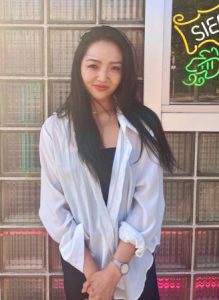
Retrospectives: An Interview with Adrienne Chung Posted in: News, Interviews – Tags: Retrospectives, Adrienne Chung

RETROSPECTIVES:
Adrienne Chung
In the Retrospectives interview series, readers have a chance to catch up with previous winners of the Open Competition and see the winding paths they’ve taken since receiving the award and having their books in print. How has their writing grown with time? How have their artistic persuasions and worldly perceptions shifted? Retrospectives considers the changing writerly self and the opportunities that found these poets after their big win.
What first drew you to poetry? What draws you now?
I was drawn to poetry as soon as I learned to read. I’d describe it as simply an attraction, though that in itself could also be said to be inexplicable, metaphysical, ontological, fated, fatal (not to be dramatic or anything—good movie though).
What sustains my attention to it is the belief that poetry is vital to humanity, that it can be an aesthetic route to insight and a conduit through which we can express and access our primordial selves: all those lofty ideals that philosophers have so kindly bestowed upon verse and which I used to think were overblown and pretentious. Reporting live that I’ve now fully drunk the kool-aid.
In the years since you wrote your winning manuscript, have you tackled new themes or subjects you didn’t expect? Was it a matter of confidence, or finding new skills and techniques?
Well, I’m waiting for the day I stop writing about my love life and my mother.
How has your poetic voice grown over time? How do you support this growth: reading poetry, trying new poetic forms, embracing discomfort, etc.?
When I wrote the poems in my book, I was really mired in my own feelings and my own pain in a way that precluded me from enjoying anything with a plot, anything that moved through time. I was in a very Terrence Malick and Disintegration Loops time of my life; I wanted to be stuck. I wanted to drown. Certainly that state of mind was very generative for me as my book is a product of that, but it was unsustainable in more ways than one. Reading my book now actually makes me sad for the person who wrote it.
To counter these tendencies, I try to engage with narrative media like television shows, short stories, plot-forward movies, anything which hinges on time passing. I don’t want to speak for all poets, but I do think there’s some connection between the poetic impulse and a sort of psychic inertia.
Has your work responded to changes in culture or social conditions? What has that looked and felt like as a writer, in big or small ways?
Early in my undergraduate career, I was taught that there were two types of poets: the private poet and the public poet. Broadly, the private poet writes about her inner world and traffics in subjectivity while the public poet is the voice of the people, the collective. This distinction gave me a lot of anxiety as a young writer, as I knew that I would always be a private–and worse, confessional–poet. It made me very self-conscious about the fact that my writing process was basically sitting in my room and rhyming tissue with abandonment issue. It wasn’t until another teacher introduced me to the work of Audre Lorde, who dissolved for me the boundary between the private poet and the public poet, the personal and the political, that I began to feel more confident about the nature of my work and understand that it’s impossible not to create work that speaks to the cultural and social conditions of the time. None of us exists in a vacuum.
How have your writerly habits (e.g., a daily practice, a preferred beverage at your side, music, writing analog) transformed since starting out? Is there a habit you want to develop or continue?
They have transformed . . . for the worse. I am nothing without the built-in deadlines of an MFA program! If anyone reading this would like to assign me a poem, please get in touch.
In winning the competition, you received $10,000 and publication. How did these things shape your life and path as a writer? Did this lead to other opportunities or a shift in your self-perception?
It changed everything! I was no longer hesitant to call myself a poet or a writer now that I was the author of an actual, physical book that I could hold in my hands, find in a bookstore, sign with my name. I thought I was going to faint when Beth Dial called with the news . . . because I had actually dreamed the night before that she’d already called me. No cap.
I was very grateful for the prize money, which gave me the freedom to travel for almost an entire year. My suggestion would be to increase the prize to $11,000 as 11 is a master number in numerology. WW1 also ended on the 11th hour of the 11th day of the 11th month. Just saying.
Have you written another book since the one published with The National Poetry Series? How is The National Poetry Series book similar or different?
No . . . t yet . . .
Who are the poets who have continued to engage you?
Ashbery, Akhmatova, Cavafy, Oppen.
If you could talk to your younger self, the version of you before you won, what would you say to yourself? What advice would you give?
This is a little embarrassing, but I’d probably tell my younger self that publishing a prize-winning poetry book won’t actually make her rich and famous overnight, and that whatever changes she’s seeking will be mostly internal (which is better anyway).
And also to get ready to meet so many amazing people! That’s been the best part about being a poet: getting to meet and befriend all the other wonderful, beautiful, talented, hilarious poets out there.
Answer an unasked question. What’s the question, and what’s the answer?
What is your favorite number and why is it 118?
Because my birthday is November 8, and 11 is a master number.