
Retrospectives: An Interview with Erika Meitner Posted in: News, Interviews – Tags: Retrospectives, Erika Meitner

RETROSPECTIVES:
Erika Meitner
In the Retrospectives interview series, readers have a chance to catch up with previous winners of the Open Competition and see the winding paths they’ve taken since receiving the award and having their books in print. How has their writing grown with time? How have their artistic persuasions and worldly perceptions shifted? Retrospectives considers the changing writerly self and the opportunities that found these poets after their big win.
Throughout Ideal Cities (Harper Perennial, 2010), your winning collection with NPS, there are numerous descriptions of what an ideal city might look like, especially in the titular poem, where neighbors reach out to one another and the whole city is beautiful in its worn-down, genuine nature. There are also many instances of the speaker’s body being a city itself, such as in “O Edinburgh”: “I never loved you because / I was a wall of a city I had never been to.” Has your ideal city—literal and/or metaphorical—changed over time?
I actually don’t think my ideal city has changed. I’m still into decrepitude and things that are worn around the edges. Growing up in Queens (NYC) in the 1970s and ’80s really shaped my aesthetics towards places that are not shiny and new, but have character and scars. I think watching people come together in Minneapolis last winter in the brutal cold to protect their neighbors, and little free libraries, and community fridges, and residents gathering at city council meetings to argue against Flock cameras are all part of my ideal city, which are sites of assembly, meaning-making, crisis, brutality, commerce, and care.
In “Preventing Teen Cough Medicine Abuse,” the speaker notes that “the poem I started with you in a motel / plateaued the poem I started with you // in a motel.” Is there a point of no return when you’re writing a draft, where a different poem takes over the one you intended? Or are your poems more like palimpsests, with old versions and ideas layered under new ones?
My poems are always smarter than I am. The worst poems are the ones where I can’t get out of the way of the poem—which can be like a runaway truck on the interstate, or a tanker ship you desperately need to turn before it hits a drawbridge, or a small slow-moving toad you’re prodding along on a path that disappears into the underbrush. Like if you try to control the thing too hard, you can kill what’s best about it. The old ideas do poke their heads up like whack-a-mole though. That’s why I’ll often have lines that repeat through three or four different poems.
You mostly write in free verse, occasionally featuring bold caesuras, such as parenthetical phrases, asides, and full interstitial gaps of negative space on the page. As you construct poems, how do you listen for the music—and silence—of poetry? How do you attend to breath? Is this something that comes in a first draft or largely through revision?
Most of the time a poem’s rhythm comes to me while working through the first draft; a poem’s form and rhythm seem obvious to me once I start writing it—and when I say ‘form’ I usually mean ‘line length.’ The content and breath are not separate for me, so it’s rare for a poem to change form entirely. But some poems are more finicky, and I wind up revising the line breaks over and over. This usually happens with the much longer-lined poems—they just need more jiggering.
In “The Chimneys in New Jersey” you note that “some stories are not mine for the telling. Some stories are not humming and breaking with light. They’re about chewing with my mouth open, something caught in my teeth.” What stories catch in your teeth? Are there some stories you felt weren’t yours to tell when you wrote Ideal Cities but are now?
Ideal Cities was published as my second book, but was actually the third full poetry manuscript I wrote. I had had a book under contract with Anhinga Press (Makeshift Instructions for Vigilant Girls) that was my true second book, and the publication got pushed back because Ideal Cities won NPS and was published so quickly. By Ideal Cities, I knew that as a speaker, I had to implicate myself and indicate my own positionality to people or events or place in a poem if I was going to write about other people’s stories. In “The Chimneys of New Jersey” I was recognizing in an explicit way that re-telling a trauma narrative—in this case, part of my grandmother’s Holocaust survival story—was not something I was equipped to do in a way I felt was ethical or compelling.
Your work has been described as documentary poetry. Can you explain what this means to you, and if this has evolved across your collections?
So while my poems often include real-life experiences, since 2007, inspired by C.D. Wright’s One Big Self and Muriel Rukeyser’s Book of the Dead, I’ve also traveled with photographers to report on various issues in verse, often on commission from Virginia Quarterly Review. During these trips, I work sort of as a journalist, researching sites beforehand, recording interviews with people I seek out or meet on the street, and turning them into poems that complement the images the photographers I work with make. I’ve done projects on the city of Detroit before and during bankruptcy and Cleveland during the 2016 Republican National Convention, both for VQR on commission. I’ve also explored gun shows in Southern Appalachia, and worked with community photo archives of the Troubles in Belfast, Northern Ireland. My most recent documentary poetry project—an ongoing study of sea-level rise and the built environment in Miami, with photographer Anna Maria Barry-Jester—was featured as a cover story for the Summer 2021 issue of VQR, though it wasn’t done on commission; they accepted the work after we made it. These projects have been included in books I’ve published that weave together the personal and political: my fourth book Copia (which includes work from Detroit); my fifth book Holy Moly Carry Me (which includes work from Cleveland and gun shows); and my sixth and seventh books Useful Junk and Assembled Audience, which both include Miami poems.
Throughout Assembled Audience (Milkweed, 2026), your new collection, I was struck by the consistent questioning of what it means to gather, and, beneath that, what it means to witness. Do you find your poetry to be a way to engage more intimately and actively with the climate crisis, with social and political turbulence, compared to simply witnessing these changes as a bystander? Do you see poetry as an act of resistance?
Yes and yes! By making a poem, which will hopefully wind up in print somewhere, you’re entering the turbulence and changes into the historical record in a subjective way. We still turn back to poems from the past to make sense of the present moment—I’m thinking here of poems like “The Envoy of Mr. Cogito” by Zbigniew Herbert, Auden’s “September 1, 1939,” and Rukeyser’s “Poem (I lived in the first century of world wars).”
Given the focus on assembly, I’m curious how you see yourself in community with poets, and how this shapes your work? Are there poets you feel drawn to, either now or in the past? Does being a mentor and teacher factor into this poetic assembly?
So much of the unseen work that I do is mentorship. I’ve been in classrooms since 1998, and I’ve taught full-time in a university setting for over twenty years, and so much of my poetic community consists of my former students from over the years. Once someone comes through my classroom they become my student for life. And I’ve learned so much from my students! But also every time I walk into a bookstore and make a beeline for the poetry section, or see a poem by a contemporary of mine on a subway car or bus via Poetry in Motion programs, I feel like I’m among friends. I’m also so constantly reading other poets’ work as part of my service to the literary community. I just finished judging for the Best New Poets anthology. I read for various artist residencies. I co-edit the University of Wisconsin Press Poetry Series, which publishes seven books a year. I read applications to our MFA program at UW-Madison every other year, and applications to our post-MFA fellowships every year, and write promotion and tenure letters for other poets. So while there’s physical gathering together, which I love to do at readings and conferences, there’s also this feeling of being in community through encountering each other’s work regularly.
How does belief operate in the new collection? Belief in religion, a higher power (which might be “the universe, / Dolly Parton, science,” or “a household battery” instead of a holy being, as you note in “A Convolution of Astral Forces”), in salvation, in endangerment, in hope, in the self, in each other?
At various artist residencies I was around people in recovery, and I was so taken with the idea that one’s ‘higher power’ can be anything at all—it truly doesn’t matter. This book is definitely one of my more spiritual books for sure. I was interested, when I was writing Assembled Audience, in where we find solace and hope collectively—especially when organized religion has failed so many. And it turns out we find it in nature, scientific discovery, music, and in others—whether they’re friends and family, or extraordinary larger-than-life icons like Dolly Parton. (RIP Dolly!)
In “I refuse to be intimidated by time,” the speaker speaks of tahara, the Jewish ritual act of purifying a body for burial by washing, a practice that the speaker expects “leads to / embodied temporal awareness.” The speaker refuses to be afraid of time, yet also speaks of poor “temporal habits,” often entrenched in the past. What would good temporal habits look like, and do you think a poet can achieve them?
I think exactly the thing about poets that makes us poets—our ability to perseverate over the past endlessly, or use our imaginations to posit the future, while also rendering us able to diligently record the present—makes us incredibly bad about “living in the moment” or “being present” at all times, which seems to be what we’re all constantly admonished to do these days. Poets are daydreamers and time-travelers.
In thinking about time and looking back, what advice might you give to your younger self? What advice would she give you?
Oh man, I think about my younger self all the time—I love imagining how incredulous she’d be at the amazing places poetry has taken me! I did a reading a couple of years ago in the rotunda of the Guggenheim Museum—a place I first went to on a field trip as a grade schooler at P.S. 221 in Queens. I’ve been to Ireland and Berlin and Rotterdam because of poetry. But so much of this work is about tenacity. I think I’d just keep shouting to my younger self: there will be so many rejections—more than you can imagine—but hang in there! And I think my younger self would tell my current self to just chill. My oldest kid tells me this all the time.
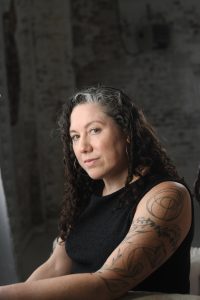
Photo by B.A. Van Sise
Erika Meitner is the author of seven books of poems, including Holy Moly Carry Me (BOA Editions, 2018), which was the winner of the 2018 National Jewish Book Award, and a finalist for the National Book Critics Circle Award, and Useful Junk (BOA Editions, 2022). She is currently a professor of English at the University of Wisconsin-Madison. Her newest book, Assembled Audience, was just published by Milkweed Editions in fall 2026.