
Retrospectives: An Interview with Kathy Fagan Posted in: News, Interviews – Tags: Retrospectives, Kathy Fagan

RETROSPECTIVES:
Kathy Fagan
In the Retrospectives interview series, readers have a chance to catch up with previous winners of the Open Competition and see the winding paths they’ve taken since receiving the award and having their books in print. How has their writing grown with time? How have their artistic persuasions and worldly perceptions shifted? Retrospectives considers the changing writerly self and the opportunities that found these poets after their big win.
Rather than opening this interview with the classic question of how a poem begins, I’d love to know how they end. When do you feel that a poem is finished, if ever?
As a young poet I’d do the unthinkable and find a poem’s ending first. I think of the impulse now as a romantic gesture toward finale, enacting endings I hadn’t yet experienced. Now that I have a lot of experience with things ending I have a very different perspective and know I can’t force it. I know when a poem isn’t done. Those poems usually sit in a file—and then I forget to revise them. A poem is done when I read it and find that the lines and sentences, the voice, imagery, and music work together as a whole. Ultimately a poem is successful when it surprises me. These standards are very personal but I use them for others’ poems as well as my own.
In The Raft (E. P. Dutton, 1985), your National Poetry Series winning collection, you develop an entire town with rich detail in “A Summer Song Cycle”—lobsters dropped in pots, chipped plaster, men drinking beer, children knifing clams—and feature a sibling dynamic as lush as a novel in “Apology’s Last Embrace.” How do you approach worldbuilding and narrative in poetry?
I love stories but am not a good storyteller, so I draw directly on my life for narratives—for everything really, even when I research a poem, which I often do. I learned how to make the narratives in The Raft from the poets I was reading at the time: Philip Levine, who was my teacher; Elizabeth Bishop; Derek Walcott . . . I was reading the Australian poet Les Murray when I wrote “A Summer Song Cycle” and borrowed a lot of his syntax and pacing to make verse out of my own quotidian working-class childhood. For me the challenge with narrative is always making a poem, the pressurized and concise form that prose, even the most poetic prose, just isn’t.
The Raft features many reflective poems with speakers remembering experiences tinged with threats—of not being believed, of losing hold of the memory, of never experiencing something again. Yet, there is nothing saccharine or maudlin in how you write about the past. What is your relationship with nostalgia? How does this relationship with the past appear in your new collection, The Unbecoming (W. W. Norton, 2026)?
I mean, I have a lot more past to consider at this point, and certainly my last two books, Bad Hobby and The Unbecoming, are dedicated to excavations of my personal experience as well as larger historical issues. The Unbecoming opens and closes with sequenced poems that reimagine childhood from the perspective of an aging, childless, bi woman on a failing planet. The book also contains elegiac and ekphrastic meditations that handle that same material on a more public scale. Who are we among many? What do we make when we make art, and why, and for whom? What do we truly value? It was my hope to face these new poems outward in community with others who acknowledge but are not crushed by the inevitability of death.
When reading your work, I noticed a propulsive force, a keen awareness of breath in lineation, and a generousness with letting an image unfurl, characteristics that are true across four decades of writing. With these core elements remaining constant, I’m curious how you feel your craft has changed over time, in technique and in subject matter? Has being in community with other poets shaped your writing?
Honestly, my students have influenced my work as much as anything. I came to poetry very young, a first-gen college student, grandchild of immigrants, working my way through school not knowing anything about anything except I liked to read and write. They were the only things I could do actually. When I started teaching I had to learn to come to terms with my own difference—it took awhile—but my students taught me by example. In turn I cared for them and wanted them to find in poetry as much as I did. It was imperative that I create a pedagogical space that was open and receptive to more modes of being and writing than I’d been exposed to. So I read more widely, across race, gender, and periods, and that helped me both in the classroom and in my own poems.
In The Unbecoming, you write that “I loved costumes as a child / feeling most myself disguised” (“Samhain”). Do you feel that your poetic speakers are disguises, and do they bring you closer to your true self?
At one time I would have said my poetic speakers were personae and disguises, not me. One advantage of age, if you work at it of course, is knowing who you are. I’m too tired for disguises now. Ìn my past three collections, I am the only speaker of my poems.
There are several times in The Unbecoming where the speaker comments on her aging body as an old bag, that her childlessness and lack of motherhood have made her feel othered in society, unneeded. I wonder how you view legacy, and how it may be tied to writing rather than reproduction?
Well, of course my poems and my students are my legacy—I won’t leave children or money behind. It’s been very instructive to age as a woman without children; it offers the invisibility and freedom most mature women experience, childless or not, but its potential for isolation is more bluntly palpable. It’s been my experience that regret declines as hormones do, and I consider myself very lucky to have found meaningful work, and to have five senses still functional enough to receive the world and all the beauty in it.
Across your collections, you explore moments of beauty: the unexpected loveliness of a drop of a blood, wistful and hidden birds, suns and skies in gorgeous technicolor. Your new work incorporates a double meaning of the word unbecoming: the unraveling of self and being seen as unattractive or tactless. Can you give us insight on this title, and its relationship with beauty and language?
When I was growing up it was common for parents, especially mothers, to scold a child, especially daughters, for their “unbecoming” behavior or appearance. I wanted to explore the juxtaposition of that peculiar use of the adjective and the noun and verb it became in the two poems of the book that use the word, one a meditation on conventional beauty and the other an ekphrastic on the conception and burial of Christ, both featuring Mary. The word, as I re-conceived of it, became emblematic of the life cycle itself, and the way we creatures shed parts of ourselves—in life, death, and all the spaces in between—so that we may transform into something new.
In Italian, the word for softness or tenderness has the same root as morbid. Death involves a softening of the body, the way light begins to run through the thin skin at our wrists and cheeks, muscles atrophying. Your work delves into bereavement and grief, the loss of parents and complicated feelings surrounding inheritance. When writing these difficult subjects, how are you tender with yourself while pressing into pain?
I’m living in Italy right now and learning the language: si, morbido. Writing through these losses I think is the way I am tender with myself and, more to the point, with my fellow creatures. Death is our future, our common fate. I at least find that a transformative understanding; it buoys my purpose.
As this collection is an ouroboros of becoming and unbecoming, it features many layers and versions of the self. If you could talk to your younger self, what would you say? What advice would you give? What advice might she give you?
Ah, I’d tell her: Don’t be ashamed. Don’t waste time. You’ll be fine. She’d tell me: Be braver.
Answer an unasked question. What’s the question, and what’s the answer?
What’s next?
55 Olive Trees and a New & Selected Poems.
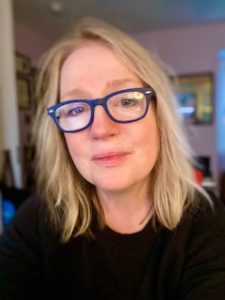
Kathy Fagan’s new book is The Unbecoming (W. W. Norton, September 2026). Preorder now from your favorite bookseller. Her sixth book, Bad Hobby (Milkweed Editions, 2022), won the 2023 William Carlos Williams Award. Her fifth book, Sycamore (Milkweed Editions, 2017), was a finalist for the 2018 Kingsley Tufts Award.
A 2023 Guggenheim Fellow, she has been awarded a National Endowment for the Arts fellowship, an Ingram Merrill fellowship, residencies at The Frost Place, Yaddo, and MacDowell, and was named Ohio Poet of the Year for 2017.
Fagan’s work has appeared in venues such as The Atlantic, The New York Times Sunday Magazine, Poetry, The Nation, The New Republic, Kenyon Review, the Academy of American Poets Poem-A-Day, The Pushcart Prize Anthology, and Best American Poetry. She co-founded the MFA Program at The Ohio State University, where she taught poetry and co-edited The Journal and the Wheeler Poetry Prize Book Series for OSU Press.