
Retrospectives: An Interview with Christopher Kondrich Posted in: Interviews

RETROSPECTIVES:
Christopher Kondrich
In the Retrospectives interview series, readers have a chance to catch up with previous winners of the Open Competition and see the winding paths they’ve taken since receiving the award and having their books in print. How has their writing grown with time? How have their artistic persuasions and worldly perceptions shifted? Retrospectives considers the changing writerly self and the opportunities that found these poets after their big win.
What first drew you to poetry? What draws you now?
Before reading Seamus Heaney’s Field Work and The Haw Lantern in the library of my public high school during lunch periods, it was my teachers who first drew me to poetry. There was one teacher in particular, Mr. Bergman, who I remember sharing new issues of The Kenyon Review and other literary magazines with us, inviting us to consider poetry not as a dead or distant art, but as a living genre. What draws me now are still the many ways a poem can make meaning, how a poem is both what is discovered and the means of discovery. And I continue to be inspired by Carl Phillips’ notion that a poem should “transform not translate” experience, meaning that poems refashion or alter what we’re writing about in some way. Phillips is reminding us that poetry changes experience, changes the way experience is expressed; it isn’t merely a photocopy of an experience in words.
In the years since you wrote your winning manuscript, have you tackled new themes or subjects you didn’t expect? Was it a matter of confidence, or finding new skills and techniques?
Since winning the National Poetry Series, I’ve written a new book, Tread Upon, which explores an individual’s role in the myriad social and environmental crises of our time. At its core, it’s about how we value the living world (and, by extension, our own species), and about how these values manifest across social and political spaces, across generations, across belief systems and behaviors. Thus, I consider it an evolution of my National Poetry Series-winning collection, Valuing, which explored the origination of our personal value systems. Winning The National Poetry Series gave me the confidence to continue writing into and out of notions of value, though this time the poems are unpacking, more expansively, systems of power, violence, and profit.
How has your poetic voice grown over time? How do you support this growth: reading poetry, trying new poetic forms, embracing discomfort, etc.?
It has gotten braver, more direct, more courageous, or to put it another way, I have learned to lean into “a dramatic pitch that makes the speaker capable of saying something more courageous,” which is how Tracy K. Smith put it in an interview I did with her for Guernica many years ago. She echoed these sentiments in a lecture she recently gave at the museum Planet Word—that a poem calls for us to be braver, that our poetic voices can be braver versions of ourselves (however that might manifest). I think we need a sense of bravery as artists to “see through our fear-stricken society and its obsessive technologies to other ways of being, and even imagine real grounds for hope,” as Ursula K. Le Guin said in her speech to the National Book Foundation.
Has your work responded to changes in culture or social conditions? What has that looked and felt like as a writer, in big or small ways?
Absolutely. In Valuing, social and political conditions show up in subtle ways. They’re in the background of many poems in the collection, and occasionally bubble to the surface. In “Black Paintings,” for example, I write “what are you but your ration for today of things happening without your knowledge, in your name.” With the work that I’ve done since then, I’m much more interested in naming these things specifically, while still permitting a poem to surprise me and go beyond what I already know.
How have your writerly habits (e.g., a daily practice, a preferred beverage at your side, music, writing analog) transformed since starting out? Is there a habit you want to develop or continue?
In recent years I’ve begun to use research much more prominently and intentionally in my work. I now love using journalism, scholarship, and archival documents as places to begin. This was not something I was doing when I wrote Valuing. The poems in that collection were inspired by the writings of theologian and philosopher Simone Weil, but were not utilizing research beyond this. I’m currently using both visits to and texts about mines and landfills to write poems about extraction and disposal, which was not the kind of thing that was a part of my process previously.
In winning the competition, you received $10,000 and publication. How did these things shape your life and path as a writer? Did this lead to other opportunities or a shift in your self-perception?
Jericho Brown selecting my book as a winner of the competition was transformative for me in terms of my confidence as a poet. Valuing took about five years to write and another three to find a home, so it was an indescribable feeling to hold the physical object that the University of Georgia Press produced. It broadened my community and the circle of other poets and writers I’m lucky enough to be in conversation with. I’m currently Poet-in-Residence for the University of Maryland’s MFA Program in Creative Writing, and this would not have happened without the National Poetry Series. I remain incredibly grateful.
Have you written another book since the one published with The National Poetry Series? How is The National Poetry Series book similar or different?
My third book, Tread Upon, was published in April 2026 by Copper Canyon Press. Valuing was a collection of poems whereas Tread Upon is a book-length sequence. I already discussed how I see Tread Upon as an evolution of Valuing, so let me mention the structure of the new book as a major difference. Tread Upon begins with a prefatory poem. As you read the book, you’ll notice that certain words/phrases appear on their own pages in the same spot that they appeared in the prefatory poem. These words/phrases are reused as section titles and give the poems of each section a conceptual frame. While there’s an arc to Valuing, it doesn’t have this kind of intentional structure. I’m really interested in how structure can contribute to the overall meaning-making that a book is doing.
Who are the poets who have continued to engage you?
Jorie Graham, Alice Oswald, Robyn Schiff, Raúl Zurita, Eleni Sikelianos, Jericho Brown, Vijay Seshadri, Brian Teare, Jennifer Chang, Kathleeen Graber, and Kim Hyesoon, just to name a few.
If you could talk to your younger self, the version of you before you won, what would you say to yourself? What advice would you give?
I would implore my younger self not to be so precious about every single poem. I would hand myself a copy of Art & Fear by David Bayles and Ted Orland. “The function of the overwhelming majority of your artwork,” they write, “is simply to teach you how to make the small fraction of your artwork that soars.” This is a truth I needed to understand as a young poet, and still do.
Answer an unasked question. What’s the question, and what’s the answer?
I wrote this for my students:
What is a poem?
A poem is a door that one uses words to pass through. It is both a text and an experience—the door itself and the act of passing through it, and, as such, a poem is both what is discovered and the means of discovery. It leads one either to the interiority of the external world or to the externalization of one’s interior life. The door is drawn on the page, on the poet, and on the ear. The poem’s primary reality is that it is heard. A poem has a sonic topography. It lives in sound and rhythm, in the interplay between stressed and unstressed syllables. A poem is culmination, accumulation, accretion, and place. It is confluence and constellation. A poem must change the one who writes it. A poem is changed by being written, must change by the time it comes to an end. It is itself change, and moves by increments called a line. A line is uttered and heard. Its origin is breath; a poetic line is breath one can read. A poem is one’s body—the muscle and tendon of syntax, the nervous system of urgency and risk—and must resound in the body, must reverberate there. A poem must call the whole of a body into being. A poem traces the touch of the body on space. A poem realizes itself formally. It emerges out of the form the words want to take. A poem makes meaning multiply: through sound, sense, and form. Its meaning arises through interplay, negotiation, implication, and subversion. A poem must subvert itself. A poem must subvert its writer. A poem is only ever partially written.
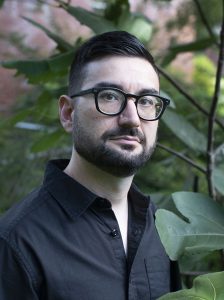
(Photo by Louie Palu/ Agence VU)
Christopher Kondrich’s third book, Tread Upon, was published by Copper Canyon Press in April 2026. His previous collection, Valuing (University of Georgia Press, 2019), was a winner of the National Poetry Series, a finalist for The Believer Book Award, and was selected by Library Journal as a best book of the year. His poetry appear widely in such venues as The Atlantic, The Kenyon Review, Los Angeles Review of Books, New England Review, The Nation, The New York Review of Books, The Paris Review, Ploughshares, and The Yale Review. He has received fellowships from MacDowell, Yaddo, and the Virginia Center for the Creative Arts, and is currently Poet-in-Residence in the MFA Program in Creative Writing at the University of Maryland.