
Retrospectives: An Interview with Teresa K. Miller Posted in: Interviews

RETROSPECTIVES:
Teresa K. Miller
In the Retrospectives interview series, readers have a chance to catch up with previous winners of the Open Competition and see the winding paths they’ve taken since receiving the award and having their books in print. How has their writing grown with time? How have their artistic persuasions and worldly perceptions shifted? Retrospectives considers the changing writerly self and the opportunities that found these poets after their big win.
What first drew you to poetry? What draws you now?
I wrote my first poem in daycare when I was about four years old, just because I wanted to. It’s hard to say what starts an interest so early that it feels innate, but I’m sure my parents’ love of reading and talking about words had a lot to do with it. I’ve always felt most at home tinkering with the nuances of language. More importantly, there have been multiple times when I felt completely disconnected from life, but then reading the right poem in the right moment startled me back into connection. Some poems give me an actual physical sensation in my stomach, similar to the first drop on a roller coaster. Even when I’m frustrated and not sure how to execute a project, I keep following the impulse to return to writing, waiting to get swept up in the flow of it again.
In the years since you wrote your winning manuscript, have you tackled new themes or subjects you didn’t expect? Was it a matter of confidence, or finding new skills and techniques?
I’ve never written two books the same way—and I’ve tried! After I finish a project, there’s a period of postpartum depression and wandering, trying both to land on the next focus and to learn how to write the next book. It’s a continual process of finding new everything—subjects, themes, skills, techniques, perspectives, beliefs, coping mechanisms. That’s what makes the practice interesting (though also punishing when it’s not going well); anything that gets reduced to a formula ceases to feel compelling. Intuitive reinvention seems particularly essential in the age of AI. It’s part of what differentiates human-created art that moves other humans from something that just mimics the trappings of human expression and kinship.
How has your poetic voice grown over time? How do you support this growth: reading poetry, trying new poetic forms, embracing discomfort, etc.?
My mentor in college, Saskia Hamilton, told me I’d spend my whole life figuring out what a poem is. In high school, I was taken with Lawrence Ferlinghetti and E. E. Cummings, but also slam and performance poetry. In college, at Barnard and Columbia, I came to appreciate a more distilled but innovative lyric through poets like Saskia, Lucie Brock-Broido, and C. D. Wright. The MFA program at Mills had an emphasis on experimentation and political concerns. Those varied influences have served me well in reinventing what a poem is to me in each moment. The love of poetry as a whole, rather than one particular school, is freeing. I’m willing to explode whatever I did last and see where the pieces land. The questions I’m grappling with in an individual poem or larger project will reveal a corresponding approach and form. “Voice,” then, seems like a matter of discernment and intuition—in the universe of all possible things you could say and ways you could say them, what are you uniquely called to express?
Has your work responded to changes in culture or social conditions? What has that looked and felt like as a writer, in big or small ways?
With each passing year, I grapple more directly with the dissonance that comes from watching intense human and ecological suffering unfold in parts of society and the world while other parts are not directly touched for the moment and people cling more tightly to denial. I’m interested in creative writing’s potential to engage with entrenched sociocultural dynamics and, instead of veering into propaganda, call accepted truth into question. Writing a poem is not a life-or-death activity the way fleeing a wildfire or surviving an encounter with armed state actors is, but as a result, there’s room to sneak up on readers and shift the conversation—and maybe part of the culture—somewhere unexpected.
How have your writerly habits (e.g., a daily practice, a preferred beverage at your side, music, writing analog) transformed since starting out? Is there a habit you want to develop or continue?
When I started my MFA program straight out of college, social media was in the early days and not a central part of life. Smartphones wouldn’t come out for a couple more years. It’s impossible to overstate how much better that landscape was for writing. I had a friendlier, more constant relationship with moments of idleness and boredom; they were the time when new ideas arrived. I loved turning potential lines over in my mind and making subtle changes before finally writing them down. Today, I waste a depressing amount of time yanking myself out of the mindlessness of the algorithm—and I’m not even that online.
One of my most fruitful habits of the last year has been remotely coworking with a member of my writing group one or two mornings a week. Writing used to be a very solitary pursuit for me—I didn’t feel the need for an external accountability structure. But I’ve found committing to signing on at a certain time and sharing what I did at the end excises a lot of garbage from my morning. The full writing group is also hugely helpful, and I hope it never ends; we’re all Mills MFA alums who graduated the same year and have been meeting monthly ever since to workshop and set goals.
In winning the competition, you received $10,000 and publication. How did these things shape your life and path as a writer? Did this lead to other opportunities or a shift in your self-perception?
Before I got the finalist notification, I’d been in the phase of wandering to find my way to a new project and feeling despair about it. I’d actually thought about not writing anymore, because it felt too painful. That notification gave me the optimism to hang tight and see what happened, though I wasn’t counting on anything, since I’d previously been a finalist with two other manuscripts. Winning gave me a huge vote of confidence. It allowed me to go on a sequence of adventures reading at book festivals and on the radio, visiting far-flung bookstores, publishing in places like Lit Hub, and meeting other writers I respected.
It also revealed something that sounds like a platitude but is a core truth: On the other side of any achievement or recognition, it’s still just you and your work. Marrying yourself to the creative process is a recipe for lifelong growth—artistically, emotionally, spiritually, or however you conceive of it. Getting attached to accolades is a recipe for misery, even for the most outwardly successful artists. I absolutely still have goals for myself and pursue them all the time, but I try to keep a loose grip on the results.
Have you written another book since the one published with The National Poetry Series? How is The National Poetry Series book similar or different?
I’ve written a poetry collection and a memoir in essays, and I’m working on another poetry collection now. The more time passes, the more settled I feel in myself, and the more I unapologetically share my perspective and experiences, with little plausible deniability to hide behind. The combination of experimental, lyric/confessional, and political influences continues to shape my work, but I have an increasing sense of ownership, staking a subjective “I” from which to experiment and consider political/social questions. Borderline Fortune felt like a huge break from my previous work, and I hope to build on what I’ve learned from earlier projects while being willing to diverge from them as much as the new pieces call for.
Who are the poets who have continued to engage you?
Too many to list—I continually return to the pantheon of writers who got me hooked on writing and whose work I would follow anywhere. When I can’t remember how to write a poem, I often think about lines from Linda Gregg’s “New York Address” and Lucille Clifton’s “note, passed to superman.” Even if I can’t get unstuck, I’m just so glad those poems exist. But lately I’ve also enjoyed reading small journals and encountering poets I’ve never heard of. Engaging with poems on their own terms is satisfying, without any of the “po-biz” trappings of academic or publisher affiliations.
If you could talk to your younger self, the version of you before you won, what would you say to yourself? What advice would you give?
Just keep going. Write what you feel called to write. Nothing appeals to everyone, but there will be someone out there who wants to be in conversation with what you have to say.
Answer an unasked question. What’s the question, and what’s the answer?
How has committing to poetry changed you?
For my whole adult life, I have been writing through grief. My grandfather had a fatal stroke at my high school graduation, and a few years later, my dad was struck and killed by a street-racing teenager. It’s hard to put myself in my exact frame of mind back then, but I think I had a sense that writing could be a form of exorcism. If I could get the experience of loss into words, then I could create a powerful piece of art—but also somehow set the loss down, launching myself into whatever came next. I felt competing pressures: the internal drive to remember, and the external message that I had a limited amount of time to get over it and move on.
My first chapbook and full-length book explicitly centered on losing my dad. No matter what I wrote then or after, though, grief continued to inform my work. Even if I didn’t intentionally return to the subject of my father, he and the process of navigating his absence persisted, opening doors to seeing other losses and absences—personal, collective, ancestral, and ecological. Those themes underpin my NPS title, Borderline Fortune, as well.
My mom and I recently marked the twenty-year anniversary of his death, which seems impossible. Part of me feels like it just happened or even that I’m bracing to receive the news for the first time. If those feelings were debilitating, I would call them unresolved trauma, but I think they’re something different. Writing through all those years has shown me that the clean breaks and phases of life dictated by conventional wisdom don’t consistently exist, if they ever do. So much of contemporary American society relies on dissociation and denial, states that poetry subverts. A poem can serve as a vehicle for witnessing, and as we keep returning to poems, we have nonlinear experiences of time. Those recurring moments have incorporated or transmuted extreme pain and fear into something meaningful and sometimes even ecstatic for me.
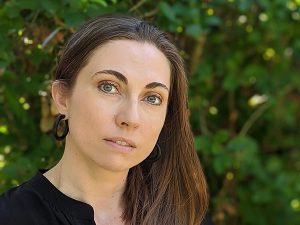 Teresa K. Miller won the 2020 National Poetry Series with Borderline Fortune (Penguin, 2021), having previously placed as a finalist with two other manuscripts. A graduate of Barnard College and the Mills College MFA program, she is the author of sped (Sidebrow, 2013) and Forever No Lo (Tarpaulin Sky, 2008) as well as co-editor of Food First: Selected Writings from 40 Years of Movement Building (Food First Books, 2015). Her poems and essays have appeared in or are forthcoming in The Rumpus, Lit Hub, ZYZZYVA, AlterNet, and elsewhere. She lives in Seattle.