
Retrospectives: An Interview with Michael Torres Posted in: Interviews

RETROSPECTIVES:
Michael Torres
In the Retrospectives interview series, readers have a chance to catch up with previous winners of the Open Competition and see the winding paths they’ve taken since receiving the award and having their books in print. How has their writing grown with time? How have their artistic persuasions and worldly perceptions shifted? Retrospectives considers the changing writerly self and the opportunities that found these poets after their big win.
What first drew you to poetry? What draws you now?
Of all the artistic endeavors (of which there were many (skateboarding, T-shirt designing, DJing, graffiti)), poetry was the one I never wanted to stop practicing. I loved any and all the time I spent on making poems. This started around eighteen years old and more seriously at twenty-one. Looking back, I think part of this desire came from finally finding a way to access and explore emotions about growing up with the homies I had. Up until that point, I was unable to articulate the complicated feelings of my hyper-masculine friendships and the undercurrent of love and loyalty I felt for those young men.
Another thing, more important and longer-lasting than my initial thematic obsessions, was the thrill of the process—the feeling that in writing I was “on to something.” I love the struggle of approximation, having only language and form to get me there. That same thrill is what continues to draw me in today. It’s why a slow/bad day of writing, when nothing seems to be clicking, is washed away by the next morning and another chance to get close.
In the years since you wrote your winning manuscript, have you tackled new themes or subjects you didn’t expect? Was it a matter of confidence, or finding new skills and techniques?
Yes and no. I write so close to my lived experience, with a speaker who’s a sort of amalgamation of myself at different ages, that what’s new is a result of time having passed since I last looked back. When I think of myself at sixteen, as an almost forty-year-old now, I’m doing that looking-back differently than when I was, say, twenty-seven, the age I started, in earnest, to write my first book. Despite the years, I find that I’m still drawn to themes of identity, masculinity, and belonging. When I do write about newer subjects, such as being a father, it’s only a matter of confidence in the sense that I am now more confident in where my curiosity might lead.
How has your poetic voice grown over time? How do you support this growth: reading poetry, trying new poetic forms, embracing discomfort, etc.?
I want to say it’s matured, but for my poetry that, to me, means being more playful, more willing to be “weird.” If not weird then at least I have a great desire to get past the initial impulse—the obvious image or metaphor—whatever that might be on a given day.
Has your work responded to changes in culture or social conditions? What has that looked and felt like as a writer, in big or small ways?
I’m sure my work has responded to cultural or social conditions, but for me, when that happens, it happens on a close, personal level, with an inward gaze that attempts to implicate the speaker. I think, too, that I’ve always tried to protect my writing from having to answer to any particular subject, event, etc. The poem should answer to itself. Lastly, for me there is and has always been a long metabolizing process to writing a poem, including poems that end up speaking to cultural and social shifts. So when those poems do arrive they are all the more surprising and thus welcomed.
How have your writerly habits (e.g., a daily practice, a preferred beverage at your side, music, writing analog) transformed since starting out? Is there a habit you want to develop or continue?
Since the book dropped, my wife and I have had three children, currently ages five, four, and one-years-old. Needless to say, I appreciate a schedule. I think I always have but that’s quite obvious to me now. A sense of organization allows me to “get weird” when I’m writing because outside of that time frame, I’m trying to be a decent dad, husband, son, brother, homie, mentor, etc.
In winning the competition, you received $10,000 and publication. How did these things shape your life and path as a writer? Did this lead to other opportunities or a shift in your self-perception?
Practically speaking, I was able to apply for and land a tenure-track job where I had been working as an adjunct. The book publication coincided with the pandemic which led to the early retirements of a couple colleagues in our creative writing program, and so that ended up as a tremendous blessing for me. A couple of years after publication, because the book had done well enough that I was still being invited to do readings and events, I was able to visit literary festivals and university reading series in person. I got to meet students, faculty, and just general literature lovers. Those visits were as much fun as they were a reaffirmation of the sense of responsibility to those who care about art.
Another thing I will admit to happening almost immediately after receiving the news that my debut had been selected—and the truth of this is, of course, all in my mind—was that I felt this sense of arrival. The National Poetry Series win came after a couple of really wonderful years for my writing (which were stacked atop years and years of practice and submission and rejection (and some acceptances)). There was, for better and for worse, a lot of sacrifice involved in the whole journey. I suppose there was no way for there to not be—I was a first-generation college student and I didn’t personally encounter any living poets until I was twenty-one. So after I learned I won the NPS I stopped to think about how my decisions had brought me here. On one hand, I’d found myself teaching creative writing and having, to me, this validation of my life as an artist. On the other, I had moved away from everyone I knew and loved and was only beginning to grapple with that, artistically and actually.
After the National Poetry Series book was published, my thought process went like this: okay so, with all that I’ve left behind, can poetry, this thing I wanted and now have, hold everything for me?—all my joy and sorrow, my delight and regret? Should a poem have to? Then I wondered: How capacious is a poem? Almost immediately I knew my poems, for the foreseeable future, would be in proximity to this question.
Have you written another book since the one published with The National Poetry Series? How is The National Poetry Series book similar or different?
Yes, I suppose I can say I just recently finished it. I always had the intention of writing a second book, but I did not intend to write any particular book, if that makes sense. My goal, after An Incomplete List of Names was published, was to write in a way so as to avoid (or attempt to avoid) any self-imposed pressure of a follow-up book. I went through this distancing period after the first book was published where I intentionally tried not to think about what my second book would be about.
Whenever I went to write poems then, this image of being lifted away and flown out of what I was calling Poetrylandia, where all the poems for the first book were written, came to me. My task was to find different routes back to myself, to Poetrylandia. I figured that each time I returned, the route I took to get there would change the way I understood and thus wrote a poem. These journeys would be where surprise and growth were possible. I know it’s illogial—to think one can find their way back to where their style was developed, as if it exists in a place—but, well, poetry is sometimes illogical, or wily at the very least. Besides, the sequence of Poetrylandia images helped relieve me of that “what’s next?” pressure. By the time I noticed some new poems—ones about fatherhood and being a son—were circling the same thematic concerns as my first collection, the new poems, in their journeying back to Poetrylandia had “earned their place,” and I had no reservations about welcoming them into a new collection.
Who are the poets who have continued to engage you?
Other debut poets. To name a few: Megan Pinto, Gabrielle Bates, Steven Espada Dawson,
Eduardo Martínez-Leyva—each with a beautiful collection. My homie, the brilliant poet José Felipe Ozuna, put me on to Sesshu Foster, too. I am in awe of Foster’s beautiful, sensory-packed blocks of poetry. Otherwise, I sort of took a break from most of the poets who heavily influenced the first book. I believe this was part of my wanting to see if I could “find my way back to myself.”
If you could talk to your younger self, the version of you before you won, what would you say to yourself? What advice would you give?
That foo wouldn’t listen and I think I’m okay with that.
Answer the unasked question: Is there an experience I’ve never forgotten, one that continues to inform my process?
In undergrad, me and my friend Freddy, a musician, were invited to write and perform a song for the unveiling of a Cesar E. Chavez memorial statue in Riverside, California. Since we worked together in a larger group, mentoring youth in the area through art workshops, Freddy and I spent a good amount of time together, writing the song—something between a rap and spoken word— a couple of weeks before the event. For some reason though, call it overconfidence, we didn’t practice much. We were excited to do the gig, to be clear, but we mostly talked about what we were going to wear and how we were going to kill it onstage.
There were several events and performances the day of the unveiling. It was a whole thing. I even invited my sister. When it was our turn, me and Freddy went up onstage. Our music dropped and I couldn’t remember the lyrics. We got past the first couple bars and then we sort of mumbled into the mic for the rest of the song, humming to the melody. I looked out and saw my sister holding a pained grin on her face. Her hands were clasped together tight in front of her. Later, another friend who was a mentor in our group, read an original poem. They did really well. I remember the admiration (and jealousy to be honest) I had for them, knowing they spent the time I hadn’t to get the performance down. I told myself I’d never not be prepared again. What I took away that afternoon, among other things, was what being a professional artist means. Not only was I responsible to the art, but I was responsible to the people who show up for that art, and to those who do their part to make an event successful—all of which is much larger than me.
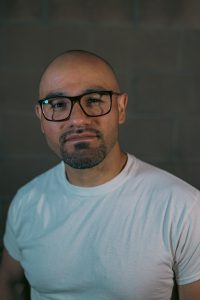 Michael Torres was born and brought up in Pomona, California where he spent his adolescence as a graffiti artist. His debut collection of poems, An Incomplete List of Names (Beacon Press, 2020) was selected by Roque Raquel Salas Rivera for the National Poetry Series and named one of NPR’s Books We Love, 2020. Currently he’s an Associate Professor in the MFA program at Minnesota State University, Mankato, and a teaching artist with the Minnesota Prison Writing Workshop. Visit him at: michaeltorreswriter.com