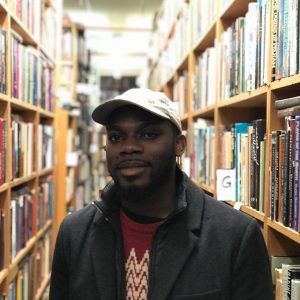
Retrospectives: An Interview with D. M. Aderibigbe Posted in: Interviews

RETROSPECTIVES:
D. M. Aderibigbe
In the Retrospectives interview series, readers have a chance to catch up with previous winners of the Open Competition and see the winding paths they’ve taken since receiving the award and having their books in print. How has their writing grown with time? How have their artistic persuasions and worldly perceptions shifted? Retrospectives considers the changing writerly self and the opportunities that found these poets after their big win.
What first drew you to poetry? What draws you now?
I have always been a student of language, even before I wrote my first poem. I remember asking my grandmother to buy me an Oxford Learner’s Dictionary for my 14th birthday, and I would spend hours traveling from one page of the dictionary to another, learning and practicing new words. And I would frequent a roadside bookstore in our neighborhood to purchase used novels such as Chukwuemeka Ike’s The Bottled Leopard, Chinua Achebe’s Chike and the River, Buchi Emecheta Joys of Motherhood, Kola Onadipe’s Ralia, the Sugar Girl, Cyprian Ekwensi’s An African Night’s Entertainment, and Zaynab Alkali’s Virtuous Woman, to name a few. The point of all this is to say that the unquenchable thirst I have for language led me to poetry. And it still leads me to it, even now, even after all these years.
In the years since you wrote your winning manuscript, have you tackled new themes or subjects you didn’t expect? Was it a matter of confidence, or finding new skills and techniques?
I’m currently working on a book on migration. It’s a new terrain for me, not just thematically but also formally, since I’m writing it in a form I had never adopted before (prior to the project). However, it’s a truly unquantifiable joy and privilege to continue learning about new possibilities as I work on this project.
How has your poetic voice grown over time? How do you support this growth: reading poetry, trying new poetic forms, embracing discomfort, etc.?
The most visible growth for me is that I now trust my poems more than I did before. By that I mean when I set out to write, I let the poem lead. For example, sometimes, I find myself midway through a poem, going to bed thinking about how to end it. The next morning, I return to the poem and realize it doesn’t require any additions. This marks a departure from a few years ago, when I would begin writing with a well-defined destination in mind.
And how I continually grow is, like most writers, by reading (to respond to the second part of the question).
Has your work responded to changes in culture or social conditions? What has that looked and felt like as a writer, in big or small ways?
I believe my poetry always responds to social and cultural changes, even when I’m not conscious of it. This is because my poetry is, in many ways, experiential, and there is no way for me to express my realities without responding to these changes—even tangentially.
How have your writerly habits (e.g., a daily practice, a preferred beverage at your side, music, writing analog) transformed since starting out? Is there a habit you want to develop or continue?
Before now, I enjoyed writing amidst distractions and noise. I suspect this had to do with growing up in Bariga, Ikorodu, and Ikotun—lively Lagos neighborhoods that buzz with activity at any time of the day. These days, though, solitude is my muse.
In winning the competition, you received $10,000 and publication. How did these things shape your life and path as a writer? Did this lead to other opportunities or a shift in your self-perception?
Winning the National Poetry Series often comes with great visibility, as you know, and such visibility, to speak for myself, often brings along opportunities. As such, winning the Open Competition has had a profoundly positive and material impact on my life. Beyond that, winning a major award like the National Poetry Series naturally reaffirms one’s belief in their book—and it certainly did for me.
Who are the poets who have continued to engage you?
Over the years, I’ve been consistently captivated by poets who use poetic forms in innovative ways—from poets such as Natasha Trethewey, Jericho Brown, Countee Cullen, and Marilyn Nelson, who bridge formalism with Black experiences, to Marilyn Hacker for her remarkable range and vision. I’m eternally grateful for the existence of these poets and their poems.
If you could talk to your younger self, the version of you before you won, what would you say to yourself? What advice would you give?
To have more faith and belief in my creative process and let my imagination grow as wild as it wants.
Answer an unasked question. What’s the question, and what’s the answer?
Why are you particularly drawn to poetic forms that primarily utilize repetition?
I love to challenge myself and write in any poetic form I encounter. Yet, I am especially drawn to forms that emphasize repetition—villanelle, ghazal, blues, pantoum, duplex, and so on. And I’ve come to believe that the reason I find these forms appealing is that they remind me of oriki—a traditional Yoruba praise song that my mother and grandmother used to sing to me, my siblings, and my cousins as a reward for doing something commendable or for being on our best behavior.