
Retrospectives: An Interview with AJ White Posted in: News, Interviews – Tags: AJ White, Retrospectives

RETROSPECTIVES:
AJ White
In the Retrospectives interview series, readers have a chance to catch up with previous winners of the Open Competition and see the winding paths they’ve taken since receiving the award and having their books in print. How has their writing grown with time? How have their artistic persuasions and worldly perceptions shifted? Retrospectives considers the changing writerly self and the opportunities that found these poets after their big win.
What first drew you to poetry? What draws you now?
The confluence of two effects: 1) when I started reading contemporary poetry, it had immediate emotional effects on me, and 2) I did not understand how these effects were being manufactured, literarily, which I found compelling.
I don’t often feel compelled by anything, outside of the natural world, and I quickly realized I would have to undertake a kind of apprenticeship to be able to practice this art and to be empowered to evoke and to appreciate most fully these effects.
Since I have entered into this lifelong apprenticeship, it’s my fellow practitioners who I find of greatest interest now. I appreciate being in the community of poetry-adjacent people. I have also become habituated, daily, to writing newer, stranger, and hopefully more truthful and revelatory things, which has its own, gentler, less urgent but nonetheless compelling edge.
In the years since you wrote your winning manuscript, have you tackled new themes or subjects you didn’t expect? Was it a matter of confidence, or finding new skills and techniques?
Yes and no. I think I am still writing into what is a self and what is a mind and what is a self and a mind that have experienced loss, which I feel is the condition of humanity. I have approached these questions in new ways. I have written science fiction poetry. Through this and other modalities, I am writing more about the future and less obsessively about the past.
I think confidence and technique go hand in hand. Using new techniques entails having the confidence to use new techniques, which then re-affords that same confidence (you don’t have it until you do it). I don’t think I’ve written unexpectedly yet. I am trying to write more unconsciously (or un-self-consciously), which is similar.
How has your poetic voice grown over time? How do you support this growth: reading poetry, trying new poetic forms, embracing discomfort, etc.?
Voice is, I believe, an amalgamation of other voices. I shouldn’t even say “other”: we are all iterations of one human voice, which speaks about the experience(s) of being human. I believe the desire to sound both new and timeless is an engine beneath most poetry. Finding styles and forms through which one might say old things new ways. “New,” itself, is funny. It often actually means hermetic. Sealed. Origins unknown. Seemingly new; practically obscure. Thinking about voice gets me talking funny, as you see. I try not to think too much about voice.
Has your work responded to changes in culture or social conditions? What has that looked and felt like as a writer, in big or small ways?
Yes. Always. Because of the internet, we are all inside culture all the time now. 24/7. In response, I try to think about where and how culture still is what it was before, and what it will and can be.
How have your writerly habits (e.g., a daily practice, a preferred beverage at your side, music, writing analog) transformed since starting out? Is there a habit you want to develop or continue?
It’s been the same for many years now. It is: daily, morning, coffee, silence (other than outside-sounds), handwriting. Not too much coffee: one coffee, then seltzer water.
Increasingly, I put handwritten poems away for longer and longer before I return to them to see if they’re any good or not. Many months, usually. I can fill up three full-size yellow legal pads before I get them all back out and go through those 150ish pages to see what I was up to a season or two ago. It helps me create distance between poem-formulator-self and poem-curator-self.
In winning the competition, you received $10,000 and publication. How did these things shape your life and path as a writer? Did this lead to other opportunities or a shift in your self-perception?
Inarguably yes. I was a graduate student: that money was sustaining. And having a book out in the world is sustaining, even more than money, for an artist. I have my book right next to me. Part of the morning routine I mentioned above is also: the book is right here. I can see it as I sit down to write. I know I am on the right path for me. I know, now, that some other people are, in any small way, sustained by some things I write. So I will go on.
Have you written another book since the one published with The National Poetry Series? How is The National Poetry Series book similar or different?
Yes. I’ve written a very different book, and I’ve written another book that’s very much a continuation of Blue Loop. Both are immensely important to me. Both show me, in the hazy aggregate, a kind of shape of a career in writing that goes on beneath, behind, after them.
But, I will add: I knew I wanted to write a first book that would be “good” enough to win NPS. Speaking of compelling: the NPS standard compelled me to write a first book I could never, I don’t think, write again. It contains a lot of pain, and also a lot of ongoingness or resolve. The value of this prize is not only in money and publication: its reputation and sustainability raises the bar of poetry being produced, I believe.
Who are the poets who have continued to engage you?
Stonehouse. Jean Valentine. Sharon Olds. Victoria Chang. Terrance Hayes. Gabrielle Calvocoressi. Catherine Barnett. Charles Wright. W.S. Merwin. Joe Weil.
If you could talk to your younger self, the version of you before you won, what would you say to yourself? What advice would you give?
Oh man. That sounds dangerous. I would send someone else, a peer or mentor, and I would have them tell me what they did tell me: you are on the right path. You are doing the right thing.
Answer an unasked question. What’s the question, and what’s the answer?
How do we make difficult choices?
I think, hopefully, it’s instinct over intellect.
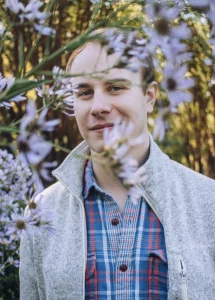
AJ White is a poet and educator from Georgia and the author of Blue Loop, which was selected for the National Poetry Series by Chelsea Dingman and published by University of Georgia Press. AJ has won the Willie Morris Award for Southern Poetry and received support from the Sewanee Writers’ Conference. His poems have been published recently in The Account, Best New Poets, Blackbird, and elsewhere. AJ lives and teaches creative writing in New York.